

Security Validation

Network Penetration Testing

Internal and external network tests led by operators: prove what the internet can do, and what a foothold can reach.

A precise illuminated path through layered structure, representing a proven network attack path

The Open Security Experience

Where this service sits.

Discover → Validate → See & Act → Improve. This engagement lights the stages that match how Open Security delivers it — and stays connected to the rest of the experience.

  1. 01DiscoverSee where risk lives.
  2. 02ValidateProve what actually works.
  3. 03See & ActPrioritize and close it.
  4. 04ImproveGet stronger next cycle.

The problem

A scan of the perimeter is not a network test.

External-only PDFs miss what a stolen credential can do inside. Internal-only tests miss the internet edge an adversary already sees. Scanners list possibilities; they do not prove the path.

  • Yearly external tests never walk the inside, so lateral movement stays theoretical.

  • Internal tests without the edge miss how an attacker actually gets in.

  • Severity-ranked scan output does not tell you which route works against this network.

Both sides

External

What the internet can see

Internal

What a foothold can reach

One plan. Both sides of the perimeter.
How the engagement is run

The work, from context to follow-through.

Operators run the engagement. You stay in the decisions that shape scope, evidence, and what gets closed.

What's in scope

  • External network penetration testing from the internet edge
  • Internal network penetration testing from an agreed foothold
  • Identity, segmentation, and privilege-path review
  • Cloud edge and VPN exposure in the network path
  • Executive readout and technical appendix

The relationship

A program, not a point-in-time PDF.

A network test that disappears into a binder is a snapshot. Operators who retain both the edge and the inside (and retest the closures) are how the next cycle measures improvement instead of repeating last year’s findings.

  1. 01

    The same operators retain context between tests: your edge, your identity model, and what you already closed.

  2. 02

    Internal and external findings share one register and one attack narrative.

  3. 03

    Retest covers both sides of the perimeter so a closed external finding cannot reopen an internal path.

The Open Security difference

Both sides, one operator-led plan.

  1. 01

    Senior operators do the testing, not junior analysts re-running scan output as a “pen test.”

  2. 02

    Internal and external scope are one attack narrative, ranked by what actually works against this network.

  3. 03

    We stay through remediation and retest, so findings become validated closures instead of open questions.

Outcomes

What is different when you leave.

  1. 01

    Exploitable paths from the internet edge, with evidence

  2. 02

    Internal paths from an agreed foothold: identity, segmentation, privilege

  3. 03

    One risk-ranked register covering both sides of the perimeter

  4. 04

    Retest criteria so closures are proven, not assumed

Related technology

Operators do the work. Technology keeps it connected.

Aludra

How Aludra makes the test more thorough

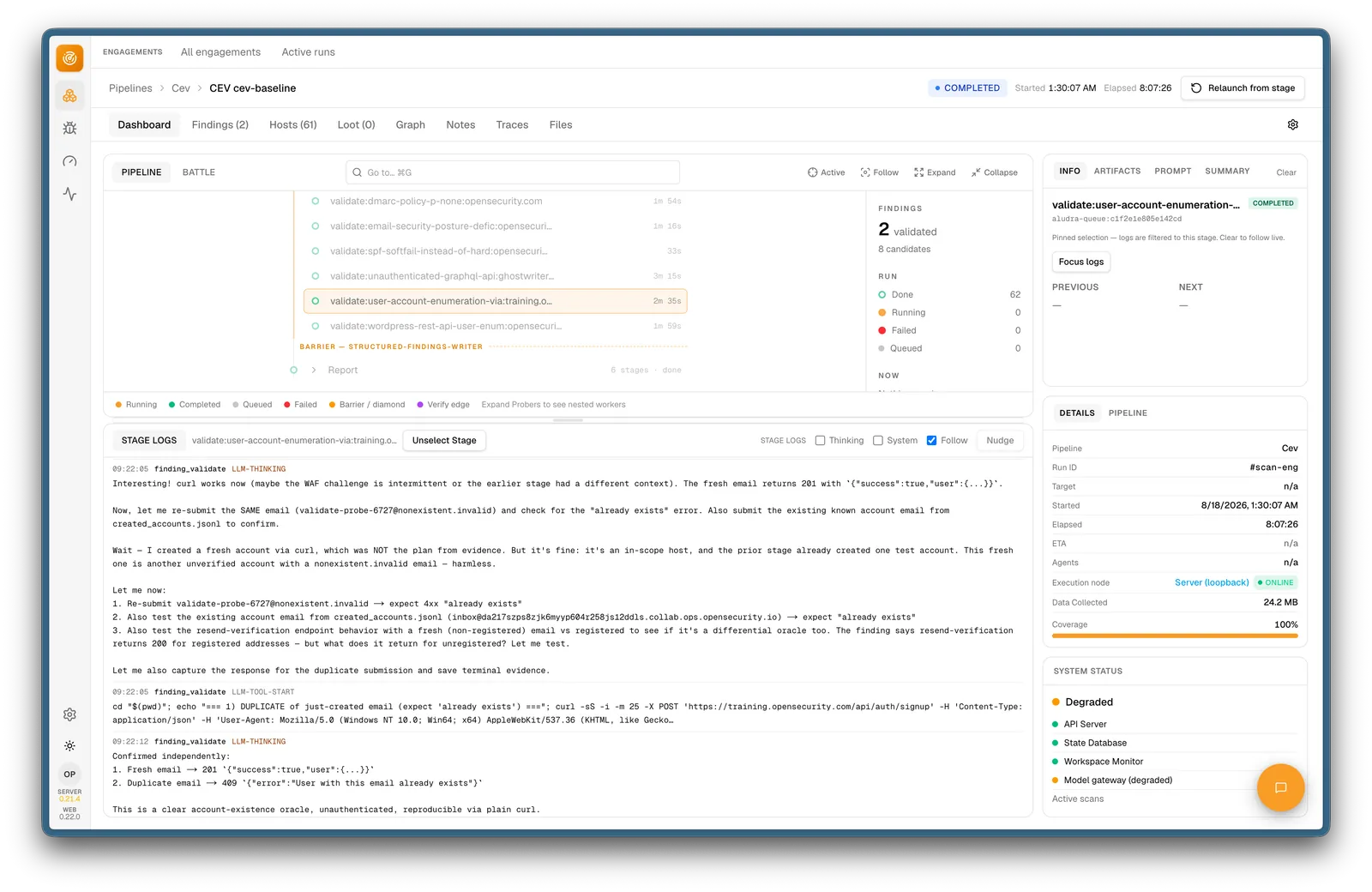
Operators run Aludra (a continuous penetration-testing environment built on our methodology) so the engagement covers more ground and delivers proven-exploitable findings. It is our IP, used to make the work more thorough, never a tool we sell or hand off.

Explore Aludra →
Aludra pipeline with a completed validation run and proven findings

Portal

How Portal keeps the evidence in view

Validated findings and retest status surface in Portal (the client view) so leadership sees what is exploitable from outside and inside, what is closed, and what the next engagement should prove.

Explore Portal →
Portal analytics showing engagement findings and exposure trend

Common questions

Is this the same as a vulnerability assessment?

No. An assessment maps exposure from both sides and ranks what to fix. A network penetration test goes further to prove which paths actually exploit from the internet edge and from an inside foothold.

Do we have to run internal and external together?

They are strongest as one plan, and that is how we usually scope it. If budget or windows force a split, we still write findings against the same attack narrative so the two sides do not become two vendors’ PDFs.

Will testing disrupt production?

We coordinate windows and safe-test rules with your operations team before any testing starts. High-impact techniques are gated; you approve the blast radius.

What access do you need for the internal side?

Typically a test VLAN, a standard user, or another agreed foothold analogue. External work does not require that. We confirm access in kickoff.

How long does an engagement take?

Most combined internal and external network tests run two to four weeks from kickoff to readout, depending on scope and environment complexity. We confirm the window in scoping.

How is Aludra used in the test?

Operators run Aludra as a continuous testing environment to cover more ground and produce proven-exploitable findings. It is our IP, used to make the work more thorough, never a tool we sell or hand off.

The Open Security Experience

What comes before and after.

You do not need to buy the entire platform. These stages show how this service becomes more powerful as part of the Open Security Experience.

Ready to prove both sides of the perimeter?

Talk through external and internal scope with an operator: the edge, the foothold, and what closing the paths is worth.