

Security Validation

Application & CI/CD Penetration Testing

Secure your software development lifecycle from initial design to deployment — without slowing the teams that ship.

Sequential chambers of light representing a software release pipeline under controlled testing

The Open Security Experience

Where this service sits.

Discover → Validate → See & act → Improve. This engagement lights the stages that match how Open Security delivers it — and stays connected to the rest of the experience.

  1. 01DiscoverSee where risk lives.
  2. 02ValidateProve what actually works.
  3. 03See & actPrioritize and close it.
  4. 04ImproveGet stronger next cycle.

The problem

You ship faster than your last security review.

Applications and pipelines change weekly; point-in-time reviews go stale in a sprint. Attackers target the seams automated tooling glosses over.

  • Auth flows, APIs, and business logic fail in ways scanners never flag.

  • CI/CD secrets and third-party dependencies open a path that no one app review sees.

  • Findings arrive as auditor language, so the team that ships cannot act the same day.

The path

  1. 01Public app
  2. 02Auth bypass
  3. 03Pipeline secret
  4. 04Production impact

The seams between the app, the API, and the pipeline are where reviews go stale.
How the engagement is run

The work, from context to follow-through.

Operators run the engagement. You stay in the decisions that shape scope, evidence, and what gets closed.

What's in scope

  • SDLC and CI/CD pipeline security review
  • OWASP-aligned web and API testing
  • Mobile app static and dynamic analysis
  • Secrets and dependency exposure checks

The relationship

A program, not a point-in-time PDF.

A single release review is obsolete the next sprint. A testing cadence that retains pipeline context, prior findings, and gate recommendations keeps pace with the teams that ship.

  1. 01

    Operators learn how your teams release — so the next test is not a cold start on a new repo.

  2. 02

    Findings and gate recommendations stay attached to the pipeline, not a one-off PDF.

  3. 03

    Each cycle measures whether last release’s closures still hold.

The Open Security difference

Built for teams that ship.

  1. 01

    OWASP-aligned manual testing of the logic flaws scanners miss — auth bypass, business logic, chained exploits.

  2. 02

    Pipeline and secrets review that hardens the release process itself, not just one release.

  3. 03

    Developer-friendly remediation: snippets and gate recommendations your engineers can act on the same day.

Outcomes

What is different when you leave.

  1. 01

    Authenticated and unauthenticated findings ranked by exploitability

  2. 02

    Per-release security gate recommendations for your pipeline

  3. 03

    Remediation guidance written for developers, not auditors

  4. 04

    A repeatable testing cadence that keeps pace with shipping

Related technology

Operators do the work. Technology keeps it connected.

Aludra

How Aludra extends application testing

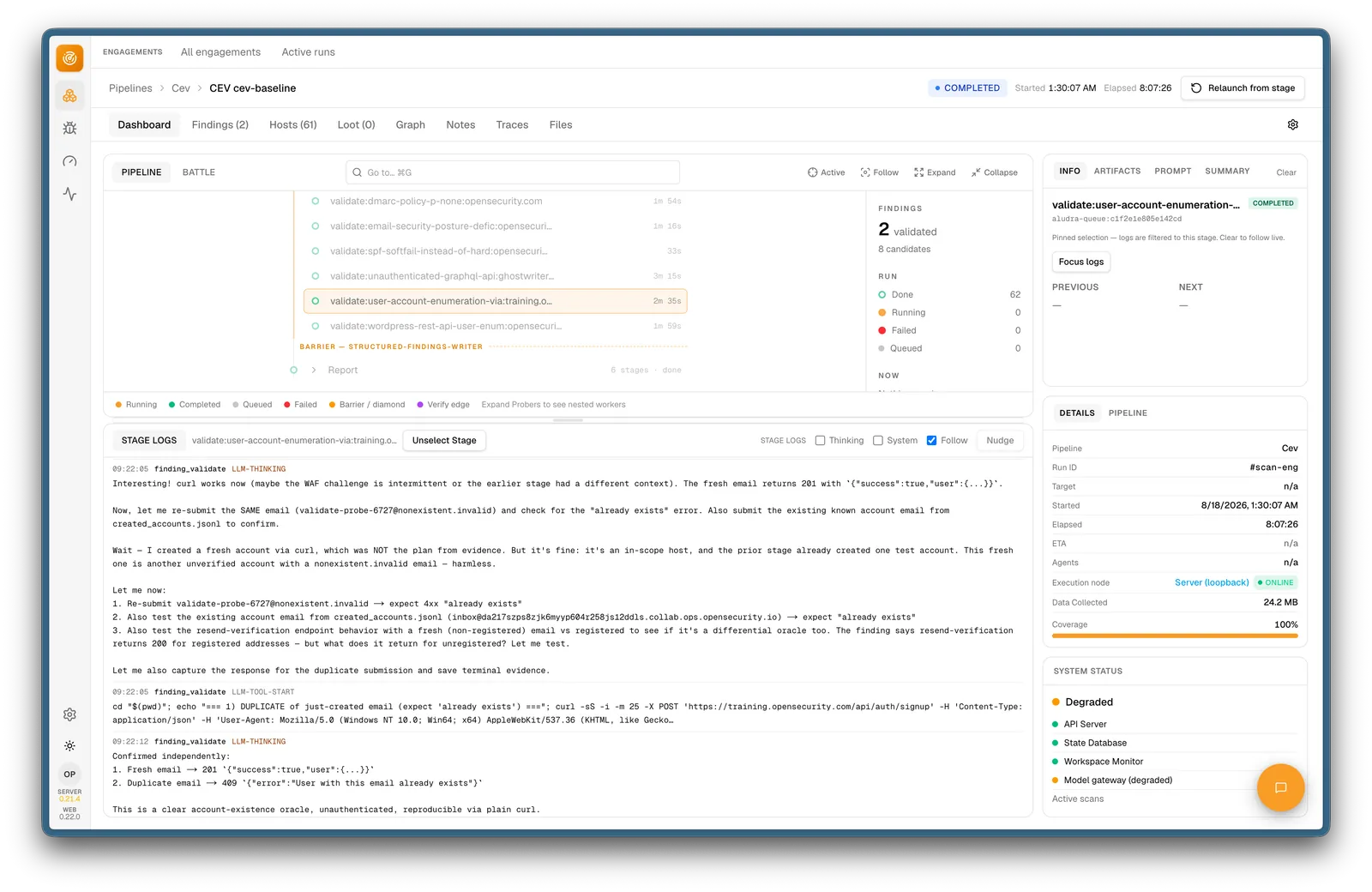
Operators use Aludra to work through discovery and exploitation on the application surface so the engagement produces proven-exploitable findings, not another SAST dump. The methodology stays human-led.

Explore Aludra →
Aludra pipeline used to validate application and API exposure

Sirius

How Sirius keeps app and infra in one queue

Application and dependency findings flow into Sirius alongside infrastructure exposure, so engineering and security work one prioritized queue instead of competing spreadsheets.

Explore Sirius →
Sirius software inventory with application and dependency exposure

Common questions

Do you test staging or production?

Typically staging first. Production testing follows agreed guardrails so we do not surprise the teams that ship.

Will this slow the release train?

The point is the opposite. We write findings for developers and recommend gates that fit the pipeline you already run.

Do you cover APIs and mobile, or only the web app?

Scope is the software you ship — web, API, mobile, and the CI/CD path that releases it. We confirm the surface in kickoff.

How do findings get to engineering?

Authenticated and unauthenticated results, ranked by exploitability, with remediation snippets. They can also land in Sirius beside infrastructure exposure so you have one queue.

Can this become a recurring gate?

Yes. Many teams start with a point-in-time test and keep a cadence tied to major releases. Context carries forward so we are not starting from zero each time.

The Open Security Experience

What comes before and after.

You do not need to buy the entire platform. These stages show how this service becomes more powerful as part of the Open Security Experience.

Test the software you actually ship.

Talk through the apps, APIs, and pipelines in play — and how testing can keep pace with the next release.