Point-in-time testing leaves gaps
Last year’s test cannot see next month’s config, next quarter’s app, or the environment you just inherited.
Aludra continuously discovers, tests, exploits, and validates exposure across your environment, giving your team proof of what an attacker can actually use against you. Built from the methodology our operators use in real engagements, it turns a point-in-time exercise into a continuous view of exploitable risk.
Our operators lead. Aludra gives them the leverage to go further, faster, and more continuously.
The Open Security Experience
Aludra brings continuous testing into the Open Security Experience, helping your team discover what is changing, validate what is actually exploitable, act on proven risk, and continuously improve.
The problem
Annual penetration testing answers an important question: what could an attacker exploit today? Tomorrow, your environment changes. Finding a vulnerability and proving an attacker can exploit it are two different things.
Last year’s test cannot see next month’s config, next quarter’s app, or the environment you just inherited.
A scanner flags what might be vulnerable. Aludra tests whether it can actually be exploited.
Aludra takes the continuous discovery and validation so operators spend time on judgment and complex paths.
How Aludra works
Aludra strengthens the Open Security Experience (Discover, Validate, See & Act, Improve) and makes that process continuous. Operators stay in the loop for high-risk actions and findings that need human judgment.
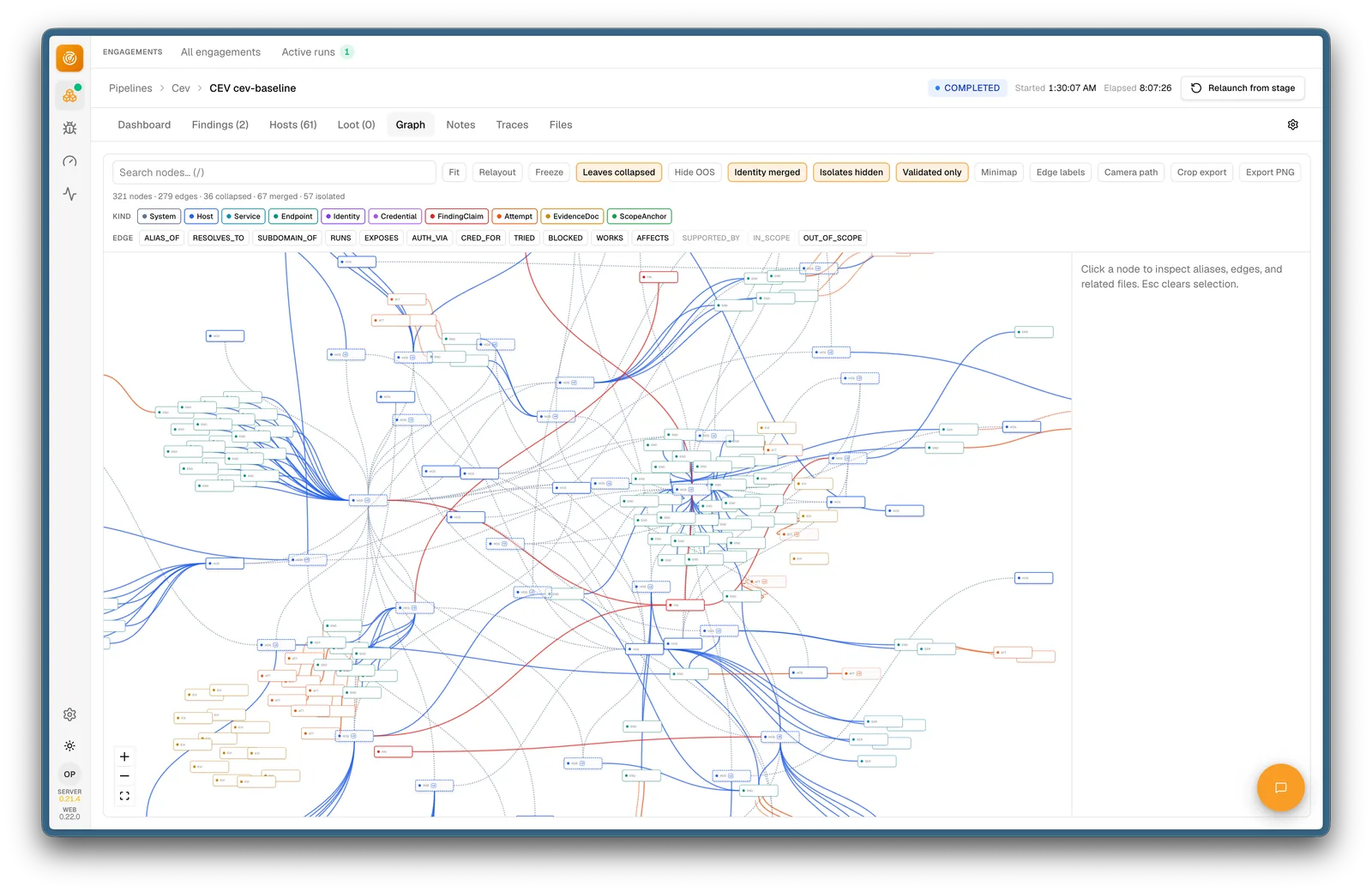
01 · Discover
Aludra evaluates your environment across applications, cloud infrastructure, Active Directory, services, and other in-scope assets. As the environment grows, it helps identify new assets, configurations, vulnerabilities, and attack paths that warrant deeper investigation.
Greater visibility into an attack surface that never stands still.
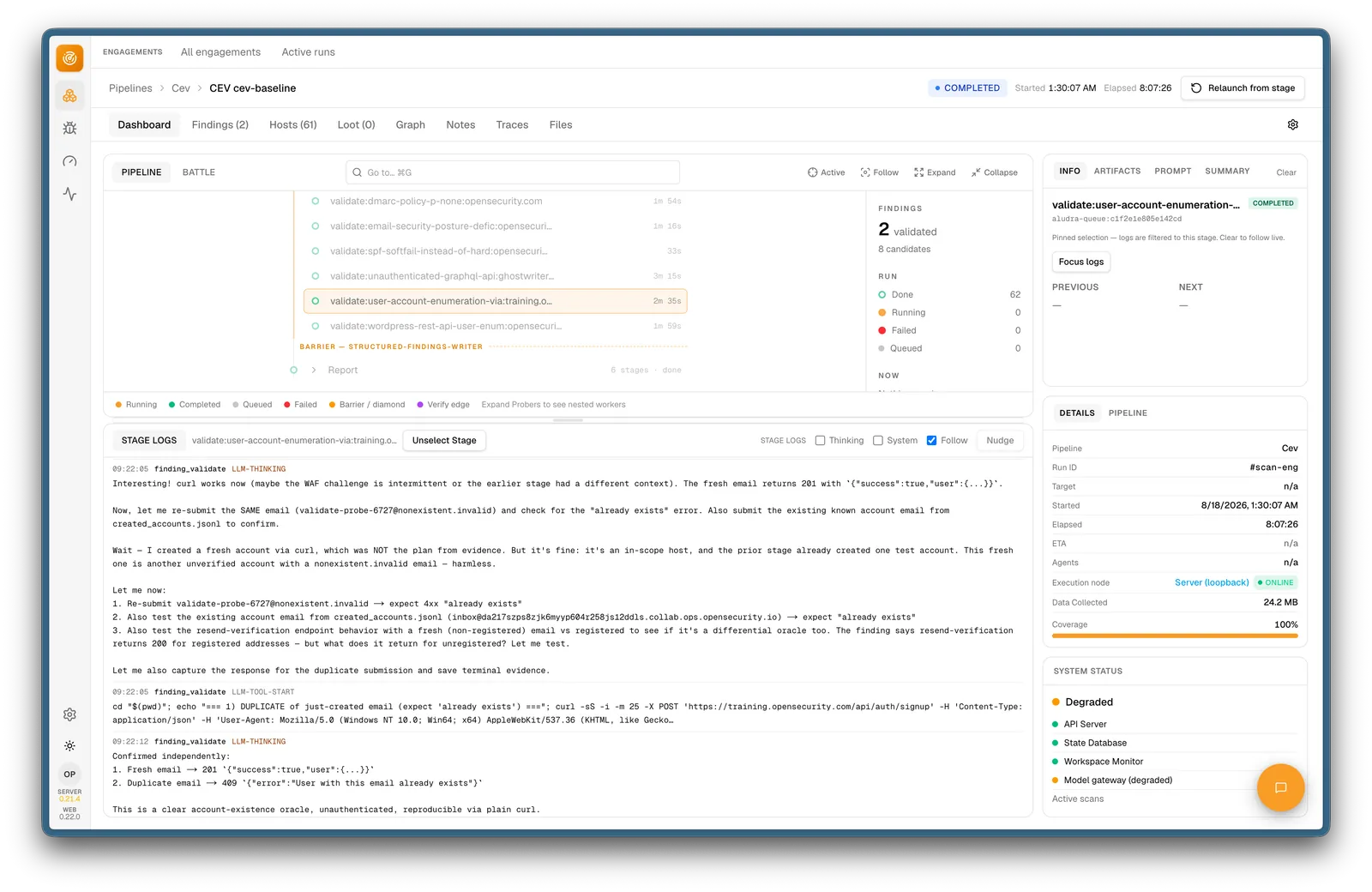
02 · Validate
Finding a vulnerability is only the beginning. Aludra researches attack paths, tests identified weaknesses, attempts real exploitation, and validates whether an exposure can actually be used by an attacker. Operators remain in the loop for high-risk actions and findings requiring human judgment.
Fewer assumptions, fewer false positives, and clear evidence of what represents real risk.
CVE-2017-0144 · SMB/445
EternalBlue
Possible
FlaggedEternalBlue
Proven
ExploitedEternalBlue
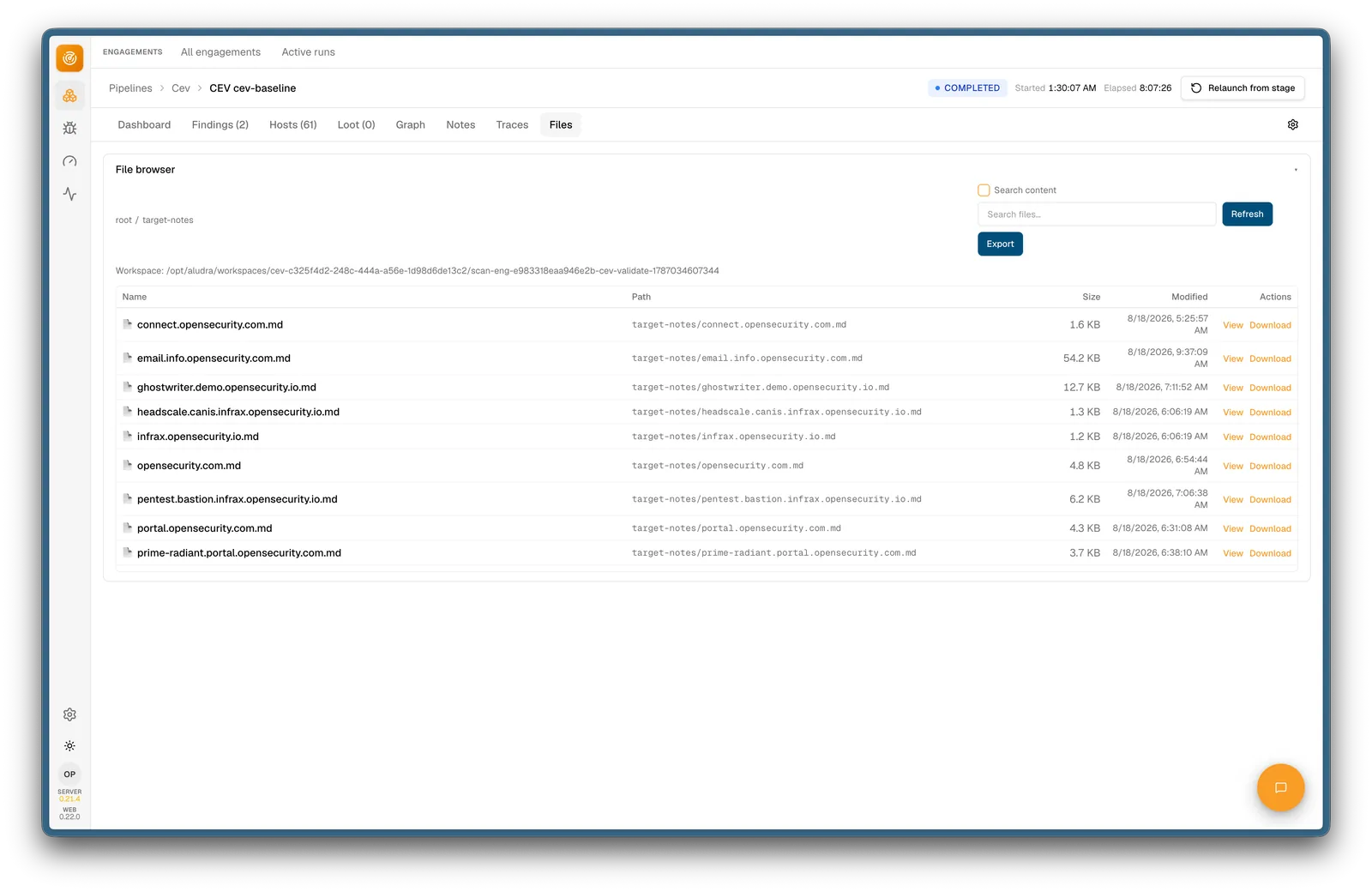
03 · See & Act
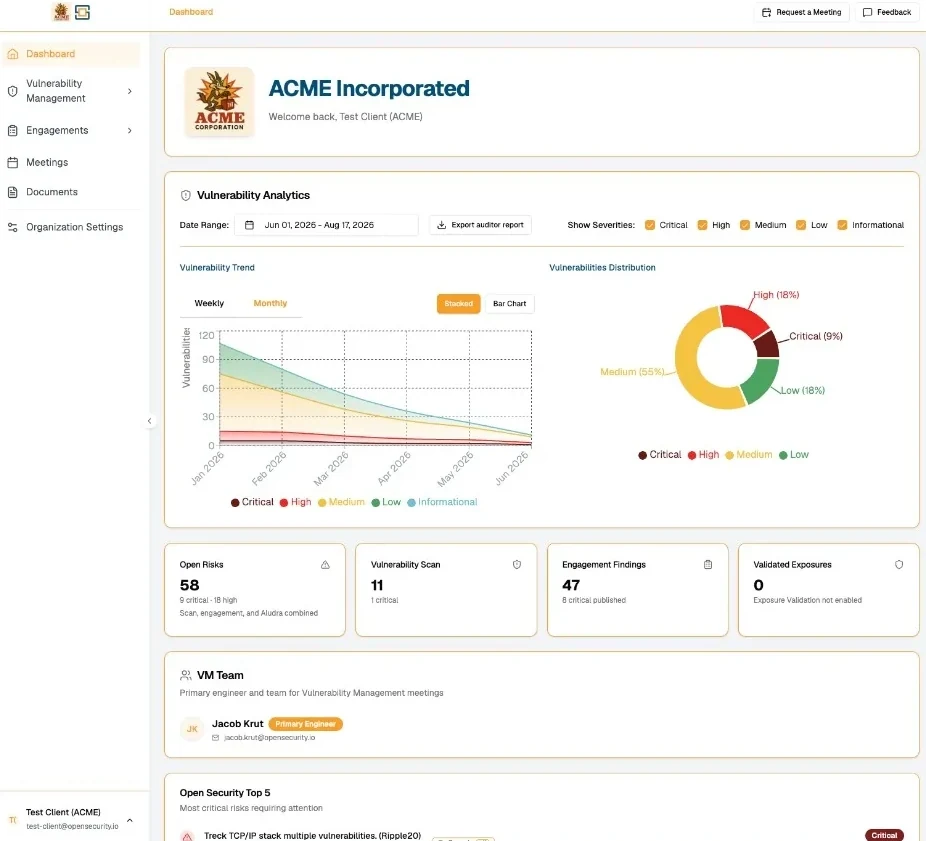
Validated exposure flows into the Portal so your team can understand what was found, why it matters, and what should happen next: prioritized, assigned, tracked, remediated, or accepted as business risk.
Actionable security intelligence your technical teams and business leaders can use.
04 · Improve
Security does not end when a finding is closed. Aludra supports continuous retesting so teams can confirm remediation actually worked while continuing to evaluate the environment for new exposure.
Continuous improvement instead of another point-in-time snapshot.
Exploitable risk over time
When you need it
Aludra is often the lowest-barrier way to start working with Open Security: a direct insert into a business situation, not a requirement to buy the entire platform first.
You inherit infrastructure, identities, and cloud you did not build, and may not yet know exist.
Know what you inherited before an attacker finds it for you.
Permissions, services, and attack paths change as you migrate. Aludra validates the environment you’re building.
Not the one you used to have.
More apps and infrastructure mean more exposure. Aludra expands testing capacity without expanding repetitive work.
More environment doesn’t have to mean more uncertainty.
Faster deals and cleaner exits at the firm. Continuous validation at the portcos, without a security-engineer army.
Clear inherited risk before it slows the deal, or the exit.
The difference
Scanners identify possibilities. Aludra tests those possibilities.
We exploit and prove. We don't just inventory.
Prioritize based on what an attacker can actually do, not another severity score.
Traditional scanner
Aludra
Human in the loop
Aludra uses AI and automation to expand the amount of discovery, research, testing, and validation that can happen continuously. Autonomous output is not the objective. Operators remain involved where judgment, context, high-risk actions, attack-path analysis, and final validation matter.
Automation creates scale. Operator judgment creates confidence.
Aludra
Open Security operators
Validated exposure
Operator-built
Aludra is not an off-the-shelf AI penetration testing tool. It is an Open Security-built environment based on the tactics, techniques, and methodology our operators use during real engagements, the harness behind that work, not a replacement for it.
Based on techniques used in real Open Security engagements.
Testing continues as the environment changes.
Move beyond theoretical vulnerabilities to proven exposure.
Operators remain in the loop where judgment matters.
Testing data remains within Open Security-controlled infrastructure.
Automate repetitive testing while preserving expert judgment.
Improve
Your exposure does not reset after an annual penetration test. As infrastructure, applications, identities, and attack paths change, Aludra continues testing and validating what those changes mean from an attacker’s perspective.
How you engage
Penetration testing gives expert depth. Aludra creates continuous leverage between those moments. They are complementary, not competing offerings.
Aludra amplifies Open Security penetration testing by handling continuous discovery, research, and validation while operators focus on attacks, decisions, and complex paths that require human judgment.
Explore Penetration TestingFor organizations that need ongoing coverage, Aludra can continue operating between formal engagements, validating changes, identifying new exploitable exposure, and confirming remediation.
Talk to an operatorThe Open Security Experience
Your environment changes continuously. Aludra helps you continuously discover, exploit, validate, and understand the exposure created by that change, so your team can act on proven risk instead of chasing theoretical findings.